Thursday, April 4, 2019

Anne Reburn

You may have seen her on YouTube.
I know that I watched her sing in harmony...
One of the earliest I remember seeing Anne Reburn was her cover of Billy Joel, that she made for hitting 100,000 subscribers.

She sings classics, putting her own twist on them.
Recently she launched some music of her own.
She graciously agreed to be on my podcast.


If you want to check out some of the songs we discussed, the links are down below.


Wednesday, April 3, 2019

More about Jack

Well I've talked to Laura Leibowitz, Kathy Seeley and now I'm talking to John Henderson.
Henderson has his own podcast called "This Day in Jack Benny".
It's where he discusses before he rolls the Jack Benny episode, some of the obscure references behind it.
Jack's show is over 80 years old by this point, and while not all the humor is topical, some of it definitely relies on references from the time.
John takes time to explain that.


I talked to him about where the idea came from, how he found Jack Benny, his love of old radio in general, and when to introduce your kids to something you love that's old.

Oh, and for Doctor Who fans, a sprinkling of Doctor Who and Star Trek.

Tuesday, March 26, 2019

Laura Leibowitz: President of the Jack Benny Fan Club--it's all about Jack

Laura Leibowitz once skipped a math class to interview Dennis Day.
     Her teacher didn't blame her, she said she would have done the same.

She took a drink from Phil Harris, and asked if it was spiked.
     But I'll let her tell the stories.

Laura is the president of the Jack Benny fan club, she just decided, and started sending newsletters.
That has grown to one of the most active, Jack loving, respectful, awesome Facebook groups I have ever been a part of....
But there are also online resources on the website and much more the fan club is working on.
She says one person accused her of trying to take over the group and make it about herself, but that pause you hear, is me giving her a crazy look because---it's all about Jack.

YouTube Version

Monday, March 25, 2019

The Bridesmaid's Daughter: Grace Kelly, fashion & a lesson in mental health


       Born in the relatively small town of Steubenville, Ohio, Carolyn Scott Reybold went from rags to riches-- to homeless.
     How does a bridesmaid for Grace Kelly and famous model end up on the streets?

Her daughter explains in the book "The Bridesmaid's Daughter".
And I explain how I "accidentally" started a podcast because of this.

    I first heard of Carolyn Reybold when I went to the Dean Martin festival for his 100th birthday celebration.
      I decided to stop at the museum to see if there was a display about Martin. Of course, there was but the staff seemed to take a shining to me.
      I was about the youngest person there that had visited from out of state and had not been dragged there by parents to see the birthplace of my beloved Dean Martin.
      I was given a personal tour, as I politely listened to an older gentleman get excited about certain things he felt he was passing on, which indeed he was, I learned more from that small museum than I have at larger ones.
      He stopped at a picture of Carolyn.


He said "do you know who she is?"

I of course, answered in the negative.


     He said "she was the best friend of Grace Kelly and ended up homeless".
He said people in town had reached out to try to offer her help, but she had refused.
She had been apparently the "It" girl for awhile, being in countless magazines.
I wondered how her fate ended up that way, and how she spent the remainder of her days, as a homeless person.

I really did not have much time to ponder this, as the men had taken such a shining to me that they wanted to show me the wonders they had in the basement, something few saw apparently.

It was a model train set. It was quite something.

     Fast forward a bit, about a year later, I forget Carolyn's name but remember her story. I tried to look up famous people from Ohio.
Nothing rings a bell.

     Couple months later, I don't know why, probably telling someone about the Dean Martin experience (because at the job I was at they lightly teased about being too young to like Dean), I looked it up again.
I believe I searched "Ohio model Grace Kelly"
POOF
I found a book had been written about her.....by her daughter. Nyna Giles.

I message her daughter on the author's page, thinking it's managed by someone else.
My literal text was WAY early in the morning saying

Last year I went to the Steubenville museum visiting for The Dean Martin festival when The guide told me about Carolyn. Her name escaped me after I went home but her story did not. It took me awhile to find her, I kept looking through famous Ohioans and Steubenville residents but her name was not there. I plan on putting your book on my must reads. I am 24 and have started to make videos and hope to launch a few podcasts about famous people if the past, right now the audience is small but I would be happy to promote your book. Are there any other resources or websites that you know of that has pertinent information?

I was really only expecting to make a podcast explaining who Carolyn was, I did not expect the author to write back.

She gave me resources then said " I'd be happy to do your podcast anytime"

At this point, I had only done a couple of videos in a series of celebrities. I did not have a podcast yet.
I thought "Oh man, I guess I have a podcast now".


I told my friends and family about this model's story and said I had gotten an interview from the daughter and author of this book.
They were excited for me.
So here it is....

This podcast has been A LOT of work. And I've made literally 50 cents off it. That's it.
BUT I love the content.
To me, sharing stories of people who did amazing work, is worthwhile.
These people are amazing, and a part of our lives.
I don't want their impact, their lives, their works--forgotten.
Or thrown away as just the past by younger generations.
It may be black and white.
But it has value.
Your favorite things and people will slip from people's memories too.
Someday I may be talking about Ariana Grande or Tom Hanks.

YouTube version


Friday, August 24, 2018

Kathy Seeley talks about Jack Benny

This episode is on the podcast but if you would rather listen on YouTube, we discuss podcasts and YouTubers and how Jack Benny could teach a thing or two to some young creators. 

Saturday, August 18, 2018

Who Mae West Was

There is so much you can say about Mae West.
I couldn't even start talking about the rumors her jailer when she was arrested for starring in the show "Sex" let her out early and she dined with him!
But to get a basic summary of who this woman is that is still risque 125 years after her birth-

Wednesday, August 15, 2018

Who is Rose Marie?


Yes, I created another YouTube Channel. 
Why?
Well, to make a long story short, YouTube politics. 
I went to Vidcon and had a talk with professionals about my channel. 
I decided that it would be best to test this theory of mine.
That my content isn't COMPLETE crap.
That there is somewhat of an audience for what I'm making.
After all, I'm passionate about it and I can't be the only one.
So PLEASE like, share, and comment on the video.
Even if you saw it before on my old channel. 


Friday, August 10, 2018

Mark Malkoff--Polite Persistence & Johnny Carson

Guys I am so excited to show off this project I have been working on!!!

I have been a long time listener of The Carson podcast (since 2014, when podcasts were fairly new). You should totally take a listen to his podcast.

 Mark Malkoff is an incredibly funny comedian and a darn good interviewer. You can check out some of his videos like where he lived in Ikea for a week or slept with celebrities in the playlist below

 We talk about his podcast, who Johnny Carson is, and how he has been able to accomplish some insane things just by asking, with polite persistence.

 Also for anyone wondering, Mark was extremely down to earth and I can't believe how gracious he has been along with everyone else being incredibly supportive.


Tuesday, June 12, 2018

All of the Classics is Back?

Hello!
    It certainly has been awhile.
I missed my blogs 7 year anniversary by 1 day.
This was my first post

    Not much has changed in those years about my taste, but in my personal life yes. I graduated from college and got my first real career full time job.

    I discovered Tumblr and took my "All of the Classics" name to that before creating more Tumblrs because All of the Classics isn't exactly a place to share pop culture memes.

    So why am I back? I feel like I keep going back to this "branding" of All of the Classics.

All of the Classics is not just TV, movies, radio or print. It's all inclusive with "all".
It's not "Old Hollywood".... that gives it a date and makes it seem like it's not a relevant thing anymore.
    No, it's "classic", it's a part of history but a "classic" look and feel is one that is a base. It's a go to. It's a must have.

    Also......the buildup......I'm launching a podcast.


I currently have a special guest I am working on and working on  booking other guests.
Right now it's on anchor and by the time you're probably reading this....it'll be on Apple podcasts and Google Play.....and pretty much all the major podcast distributors.


Friday, November 4, 2016

My Favorite Dances in Movies

WatchMojo had a fairly atrocious list of the Top 10 Dances of all time, for one--their pick for the Fred and Ginger dance is probably the least impressive (aside from Fred navigating that dress) of all their dances. 


The beautiful thing about Kelly's dances is that they always tell a story. I have watched so many Gene Kelly movies that I know whenever he had a hand in it, even if he wasn't the choreographer for the movie. For example, this dance was choreographed by Kelly even though not all the dances in this movie were by Kelly. 


This made me cry because it was so beautiful. I don't think I've done that many times before, especially at art. Real people and stories yes, so Kelly's work really hits a strong chord inside of me. 
As I said before, Kelly's dances always tell a story. Even though this is in another language, I feel like I watched a complicated romance unfold and so when people accuse musicals or movies like this of moving too fast that it's all hunky dory-I think in the case of dance numbers....the dance is showing a wide range of emotions where a mini romance may unfold.


Passion, sex, and lust. This song and dance number has it all and it's just so fun. The chemistry here is so real. The looks he gives her. They SO liked each other. They admitted it. 


So many sexual innuendos in this one song and dance number it's led to discussion among my peers as to how our parents let us watch this movie. Obviously we are love Grease and had no idea.....but even my parents were like....oh yeah....why did we let you watch this?


Here we get to see a bit more of Kelly's athleticism. We also get to see his VERY sexy legs. Sexiest man legs I have EVER seen. 


This may be the whole reason I created this list. As I said WatchMojo included just one Fred and Ginger number and it was probably my least favorite. It didn't show off Fred's skills or Ginger's nearly as good as this quick dance number did. 
By far, my favorite song and dance number. It may not be the most technical but by far the best cinematically done. It won best song. It's spell binding. 


I had a few others that I couldn't find clips for....hope you enjoyed this list. 


Wednesday, March 25, 2015

"The Late Late Show" with JAMES CORDEN

        It was a sad day for America when Craig Ferguson announced that he was stepping down from "The Late Late Show" by Christmas. Immediately a fiasco seemed to ensue, suddenly celebrity gossip columns buzzed about rumors of Letterman being responsible, of random people going to take over, and trying to make it into a Conan O'Brien type scandal.

       It was not a Conan O'Brien scandal. People who did not "get" Craig Ferguson's humor and who obviously had never watched the show before, reported about his bitterness and whoever Ferguson winked might be the next host. He was deliberately messing with the media.

       For many fans, they did not want to give James Corden a chance. Craig fan pages and websites buzzed with anti new guy hatred. They forget that once upon a time, Craig was an unknown in America, only famous for his role as Drew Carey's boss. He was pitted against other hosts and many did not believe he deserved the spot.

          James Corden had made a few guest appearances on "Doctor Who", a show many Craig Ferguson fans love, because of Craig's own love of the show, the tardis on his desk, as well as his former band member being the Doctor. So many fans were happy to hear that they could relate to Corden on some level.

      Yet the hate persisted on the Internet. Craig urged before he left, to give the new guy a chance. Corden appeared very jittery, nervous, and like a giggly schoolgirl when he first was introduced by Craig.

      After so many guest hosts and time away from Craig, perhaps it made it easier to watch James Corden take over.

       After all, the "new guy" was hilarious in his first episode.

He did a skit with many A-listers, including Tom Hanks, Mila Kunis, and Jay Leno.
 
      There were video montages.

There was jokes that did not fall flat. Which was a concern of many who thought maybe the British humor Americans would not "get", according to Piers Morgan.

      The band was OK, but there are mixed opinions there. Craig never had a band, but he isn't Craig. The band was liked by some and hated by others on Twitter.

        The set-up of the interview imitates many other British talk show hosts, such as Graham Norton's show. It's to be expected with a British guy taking over the show. Also, it seemed more free and open of an interview with the guests interacting with each other instead of the cold way many talk shows just talk to the host.
   
         It was less self obsession and more interaction. Interaction leads to hilarious outcomes in general. Johnny Carson used to do it more, and that has been an art lost somewhere.

        It was more fun than Seth Meyers in many ways. Which made me realize, as much as I love Seth, he is not the greatest host. I think he should take Colbert's old job.

What is apparent, with Colbert coming to replace Letterman, and if Corden keeps up the same level of hype (it will fall after a few episodes but, in general be more interesting), then CBS has a winner on their hands.


Monday, April 7, 2014

HIMYM Finale Review


How I Met the Finale

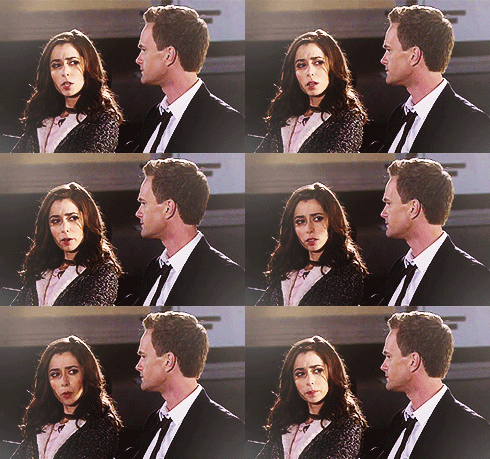
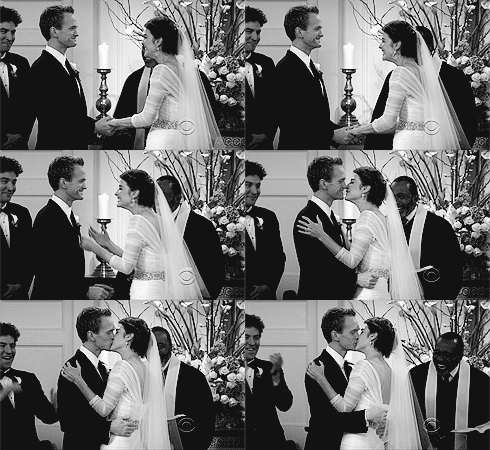
The title of the show explains the plot of the series; How I Met Your Mother is exactly that, a story about how a desperate for love man in his twenties, Ted Mosby (Josh Radnor) meets the mother of his children. The show last Monday completed nine seasons. The final season follows Ted’s friends Robin Scherbatsky (Cobie Smulders) and Barney Stinson (Neil Patrick Harris) getting married. Throughout the ninth season the mother(Cristin Milioti) has met his friends without Ted himself meeting her. They all agree that she is a nice woman that is perfect for Ted.  Predictably, all of his friends played a part in encouraging him to meet the infamous mother.  

            This hour long episode is called Last Forever. TV Guide has described the proposal of Barney to Robin as uberomantic and it is the central theme of the ninth season, a wedding between Barney and Robin.
With as quick as the plot moved, the ninth season’s plot could have done without an in detail report of a 56 hour time period.

What would How I Met Your Mother be without bringing Robin into the mix? Fans may be tired of this merry-go-round but the merry-go-round had a point that was explained why Ted bothered to share all of his drama with Robin.
            People had violent reactions to the finale of How I Met Your Mother. Some claimed that it was satisfying but there were slightly more fans that found it disappointing. The tension of nine years was hard to beat and the people who were not satisfied let out that tension with intense anger. This was demonstrated on twitter.
"Only one explanation: the finale was written after 2AM. Nothing good ever happens after 2AM" #HIMYMFinale
Worst finale ever!!! #HIMYMFinale
            Perhaps the reaction was such a drastic one because in this time some critics would say that people are not watching comedies (although the Big Bang Theory is almost always on TV Guide’s list of top watched shows). The fan base has stayed loyal, many people have joined in on the series.

According to Alex Epstein’s book Crafty TV Writing: Thinking Inside the Box, an established show’s script has to follow a format on how the characters would act, their personalities should be recognizable stereotypical version of themselves. The problem with the finale was not even the shocking plot twist. It was the fact that many die hard viewers had no idea what show they were watching anymore. The characters had changed drastically in four seasons; they retained their flaws but had seemingly learned from them. In one episode the writers discarded many character developments and story arcs.  Many character developments were forgotten that made it look like the end was not well planned out, when it has been planned since the start of the show.
            The ending made sense and would have been better received if the season had not focused on Barney and Robin’s wedding but instead gave the audience time to adjust to massive amounts of new information. The problem with the finale was all the flashbacks and flash-forwards that even though time had elapsed for the characters, the plot twists were devastating for the fans experiencing a synopsis of the characters’ next ten years in about 30 minutes, including watching the group slowly drifting away from each other
            The writers acknowledged some character growth by giving all of the characters heartfelt moments that they responded to according to their personalities.
            There were still a few highlights of the episode though. The audience does get a great deal of tributes to running gags including robots, renaissance fairs, cockamouse, and even the return of The Playbook.  The pineapple mystery still goes unsolved though.
            Even though it all does make sense, they led the viewers down a red herring road. It may have stayed true to the show in many regards but when it comes to character development, the show betrayed its audience.

            Although the episode may not be a favorite, it is sure to be counted among a historic ending, so watch it but be warned that the last five minutes may bring quite a shock. The casual viewer would probably see it as a good ending. However to the many viewers who kept up with the show and talked about it with friends, the ending is more likely to be less satisfying.
If a viewer watches it and is not satisfied simply remember the good times, forget that this episode exists. It is not worth throwing out all the good times for one episode.

Update: The Writers have declared an alternate ending will be presented on the DVDs


Thomas, Craig, and Carter Bays. "Last Forever." How I Met Your Mother. CBS. 31 Mar.            2014. Television.

"Last Forever: Part One." IMDb. IMDb.com, n.d. Web. 03 Apr. 2014.

Epstein, Alex. Crafty TV Writing: Thinking inside the Box. New York: Owl, 2006. Print.

Patricia, Rollins (Ptreee). “Worst finale ever!!! #HIMYMfinale” 31 March 2014, 8:01             p.m. Tweet.

Ensamblador (Ensamblador). "Only one explanation: the finale was written after     2AM. Nothing good ever happens after 2AM" #HIMYMFinale 31 March 2014,        8:04 p.m. Tweet.

"'How I Met Your Mother' Finale Secrets Revealed." TV Guide 20 Mar. 2014: n. pag.       Web.

Wednesday, October 16, 2013

Fangirl Reactions: Doctor Who

I did this for a class. It was supposed to be a comedy video, I could do anything though, it just had to be a slideshow. Here is the article that I had to do afterwards.

http://ahopefulworld.wordpress.com/2013/10/10/the-show-will-not-go-on/

Tuesday, July 30, 2013

The Power of Pawnee

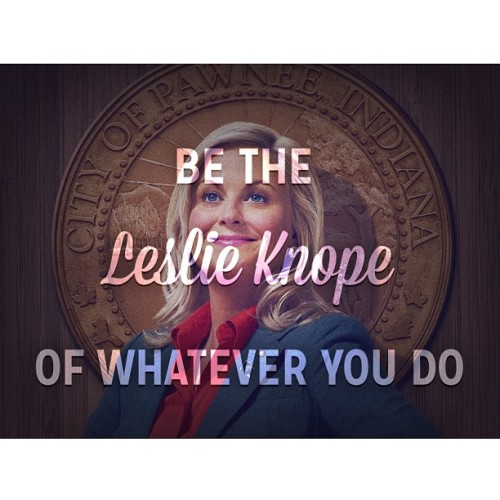
                “Parks and Recreation” stars Amy Poehler on NBC Thursday nights at 8/7c.  Recently TV Guide magazine has named “Parks and Recreation” as one of the best 60 comedies of all time. To give more insight on this show; Amy Poehler plays character Leslie Knope in “Parks and Recreation” as a waffle loving, government employee for the parks department. Leslie Knope’s childlike enthusiasm for her job is the driving influence that influences not only her local government but all the people around her, and this light hearted take on politics helps the viewer open the door to the power of a community spirit.
                Season one and two of “Parks and Recreation” showed how a fairly simple task has a mile of red tape to go through, but Leslie’s innocence and against all odds determination is what slowly makes the red tape disappear. Suddenly, everyone is in motion and the government workers that have lost the enthusiasm or never had enthusiasm, have to pay attention to this little dynamo.  Her spark is what slowly helps all of her stagnant comrades to become involved and loyal to her impressive optimism. She describes town meetings where people yell at her as “people caring loudly at me”.
                Wisely, “Parks and Recreation” stays away from many political disputes and tries not to venture into sides. Although a comedic show about a local government is not complete without throwing in some big names as well as making a character join a party (Ron Swanson is a libertarian). When budget cut time comes, he is willing to give it all, even his job, but when Leslie’s job is threatened, it is one of the first times we see Ron stand up in order to keep any form of government. He claims that the government needs her, if anybody, because she does the work of three people. Leslie Knope definitely does not have a “nope” in her, as she will do whatever it takes to help her town.
                Although the Parks Department may seem like an extra unimportant branch of government, Leslie sees its value in raising the morale of the people, and making Pawnee great. Some of the accomplishments of Leslie Knope include making the smallest park, putting on a Freddy Spaghetti concert for children, getting the hole filled, successfully launching the harvest festival again, giving a golf cart for a park ranger, creating a baseball field, organizing a li’l Sebastian memorial, and stands up for herself and coworkers. Although local citizens may be slow to acknowledge her contributions and the local media tries to look for the scandal in all things, it seems satisfactory to her that at the end of the day, she knows someone enjoyed her hard work, and she does not need the praise. She is the eternal optimist.

An ordinary workforce’s day to day life can seem dreary and non-productive but  “Parks and Recreation” challenges this by instructing the viewer to cherish the little things that is learned about people, to take hold of the small victories, and rejoice over some of the simple pleasures such as eating waffles at JJ’s.  Leslie Knope leaves a spirit of hope and a note of triumph that could do wonders to the nation if this sit-com were to explode beyond the scope it has now, and if we all decided to adopt a bit of Leslie Knope.
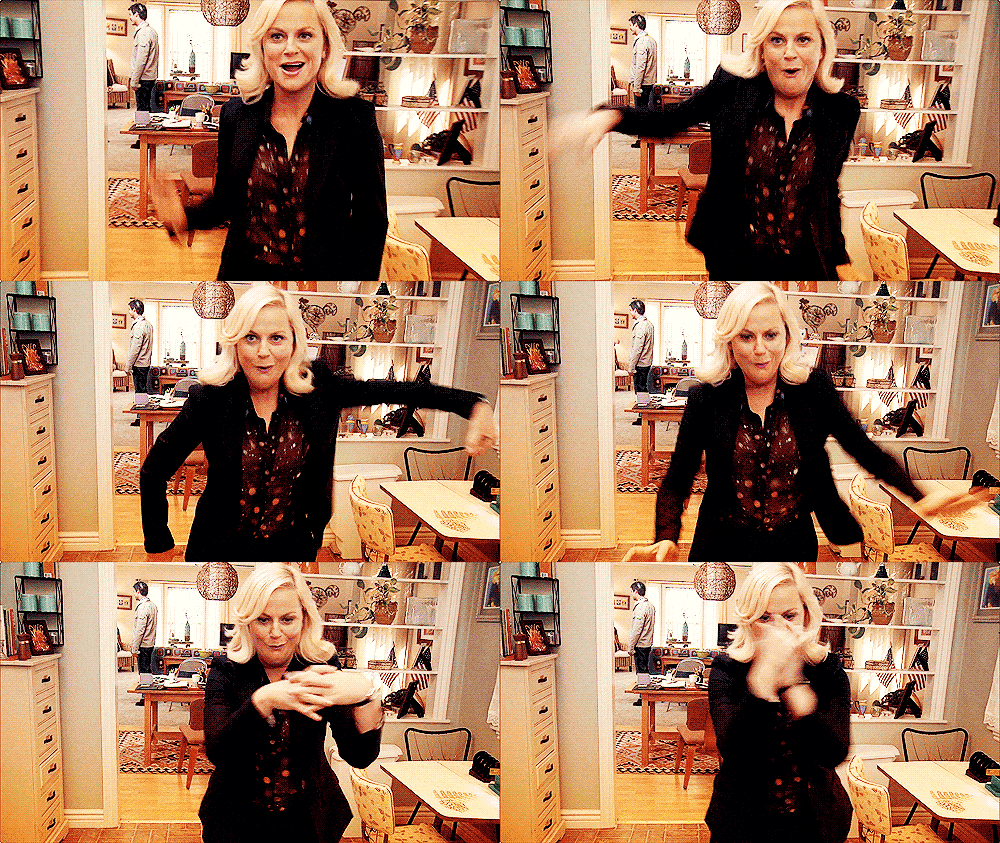
this is also my “I just had waffles at JJ’s dance"image

Friday, April 26, 2013

MetaCommentary on Television


The Author Wrote Words Here
                Meta-Commentary is when a step back is taken to observe the act that is taking place, such as when a photographer takes a photo of another photographer who is taking a picture. It is a reflection that illustrates or clarifies the act of taking a picture. This is the plight of the modern sit-com. Sometimes these sit-coms are obvious set ups that are set in a television studio setting or other times they put their characters through things that seem to be a reference point for sit-coms. “30 Rock” and “The Office” give an idea of how creating a television show looks like in a satirical way, although “The Office” is a paper company, it has been making a documentary in the classic style of a reality television set up with common reality television techniques.  This is important to modern television because in order for the genre to develop it needs to show that it can laugh at itself, and sit-coms are a commentary on society itself. When meta-commentary is involved it points out some facts that television itself has to deal with whether it is in the economy, issues of race, capitalism, social classes, and various aspects of living. In fact it can even make a statement by not really acknowledging these things, and acting like the meta-commentary is not there, while making it clear that is aware that these usual conventions are being broken, such as the case with “Seinfeld”.
This article is not really to point out what modern television show is “THE Best”, but more on what modern shows have influenced television through meta-commentary as well as remaining true to reflecting the times, and affecting the times. Personally if I were to include my favorite sit-coms the, list of shows I would discuss more in depth would include, “The Nanny”, “Friends”, “How I Met Your Mother”, “Everybody Loves Raymond”, and “Scrubs”.  I personally believe that “Friends” and “Everybody Loves Raymond” deserves honorable mentions in changing television history because of the unique sit-com styles in the writing. As much as it pains me to not really include them in my analysis, the focus is more acutely on how important meta-commentary is important to the modern sit-com.  “How I Met Your Mother”, “The Nanny”, and “Scrubs” are some of my personal favorites, and “Scrubs” has an originality that deserves praise although there is not necessarily anywhere to put that in the textbooks. Although the creator of “Scrubs” has interesting commentary on why “30 Rock” has changed television with its meta-commentary. However even these sit-coms would not necessarily seem relevant without the presence of meta-commentary in the sit-com spectrum.
 A show that first brought up the meta-commentary in a way that has a lasted impact is “The Dick Van Dyke Show”, it was a show within a show, Rob Petrie is the main character who is the head writer for the fictitious “The Alan Brady Show”, which quite humorously, Alan Brady was played by Carl Reiner, the real writer of “The Dick Van Dyke Show” (Reiner, The Bottom of Mel Cooley’s Heart). It was one of the first shows that made the public aware of the writing process, the people behind the show, and more on the problems of dealing with movie stars with flaming egos (Reiner, The Bottom of Mel Cooley’s Heart). This show paved the way for the meta-commentary that is found in many modern sit-coms, not only sit-coms that contain meta-commentary. So in this paper I want to focus mostly on the function that this meta-commentary in the modern sit com has on society and what it brings to the table for discussion on mostly social issues, but is not necessarily limited to social issues. So if you think you have what it takes to read “The Author Wrote Words Here”, read on to know how to better serve mankind.
                Situation comedy often has guest stars that are mainstream or have stood the test of time. This still continues even in live shows such as “Live from Studio 6H”, where some of the cast from Saturday Night Live is there as well as Sir Paul McCartney.  With this episode, it teaches the importance that television has had on important issues of the past but also the hypocrisy of television as if to point out the fault of the human condition. The debate “30 Rock” brings to the table for live comedy is one of a montage, spoofing old television shows that are easily recognized as a uniting factor for generations (Fey, Live from Studio 6H). “30 Rock” touches many subjects such as product placement, reality television, the writing of a show, a star’s drama, and the capitalizing nature that takes advantage of every situation, and national disaster is no exception.  With all of this, it is pathetic to watch “30 Rock” try to seem relevant by putting on that fake “Queen of Jordan” television show. Catchphrases, now that is relevant, phrases that can be employed in conversations. Such catchphrases include “I’ll take that with cheese”, and “rude”, who could be that stupid (Fey,Queen of Jordan 2)? Do people actually remember that kind of thing; do people think that it forms some kind of uniting factor when they can connect that in real life?  Although “30 Rock” is not necessarily attacking reality television with this ploy, no this is a ploy that many writers use, and despite its absurdity, it works. This needs to be stopped, these catchphrases are evil, what harm do these catchphrases do? It is so obvious that I will not even mention them. “30 Rock” even mocks itself, not a smart move, but could it possibly by mocking itself, be lending some validity to itself as well as television itself? Nah, why would anyone want to laugh at themselves? Everyone knows that if you laugh at yourself in a compromising situation then the situation only get worse because you admitted that you have cause to be uncomfortable.
                A further model of why television shows in general should have cause for shame is the fact that many business schools are using “The Office” to teach students. Television has caused these professors to become lazy and obviously on their way to inadequacy because their students are learning from “The Office”, the capital letters are indeed correct, a television show is teaching these students. Attendance is up, because honestly if I got to watch television for a class, I would love it (Kilburn 23). Do I feel like I would learn anything besides the plotline of “The Office”? In a word, no, I do not feel like I would learn very much from “The Office”. “The Office” helps students develop an idea of “what not to do in business”, which seems to be a thread throughout “The Office”. These kids will hopefully learn what to do in business by learning all the incorrect ways to handle a business (Kilburn 29). All I got to say is practice it wrong, and then you will do it wrong. What were these college chumps thinking? These students are just babies who are unable to determine the differences in acceptable and unacceptable behavior.
 Similarly, “Seinfeld”, with the characters who did not really ever develop, according to Kilburn may teach a little something on how to socially interact. What can undeveloped characters teach society to develop? Morreale points out the terrible hopelessness of sit coms in its ability to stay relevant, as “Seinfeld” pointed out so clearly in how the characters could not successfully interact with others.  “Seinfeld” is literally about nothing at all, in fact it is even defined by Jerry Seinfeld as “the spaces in between life”( Morreale 108). What the hell is that supposed to mean? In “Seinfeld”, plot conflict is often minimal. Characters pastimes include avoiding work and destroying their relationships. “Seinfeld” is a bit of a commentary on the whole genre of sit-com itself, how can that be relevant (Morreale 111)? They argue over their trivial issues in their love life too! This is not relevant anymore, people are not petty about love anymore, and people do not try to get out of work like they used to, as well as spend more than their means allow, our society knows better. At the end of “Seinfeld” we see the show wasted nine years of television space. Even “Seinfeld” put its characters on trial, and through this, its viewers, after all they had watched this abominable behavior of the “Seinfeld” clan. The final episode as stated by Larry David involved, “no hugging, no learning”, casting off former television show comedy endings (Morreale 111). This cast off the previous sit-com feeling of “warmedies” that just simply gave the audience a moral to everything while having a happy ending with a nod to their viewers (Morreale 112).“Seinfeld” also did not have any true romance that bloomed, the characters never grew in the sense that a human being would, instead they followed the model of a sitcom character that is hardly seen at work, and simply seems to consume products that seem well past their means, not even contributing to society as a whole. (Morreale 113) People will never learn how to help others if they watch people who never learn how to develop.  If you want to blame the modern plight of television comedy, “Seinfeld” ruined it by mocking the entire genre and displacing characters as well as viewers. In fact it paved the way for such atrocities such as “30 Rock” which also mocks the hand that feeds them. Rude. People did not necessarily want television characters that are just a product of their small little world after “Seinfeld”, so warm comedies were left in the past to make room for shows that were willing to mock their own existence. In fact “Seinfeld” tore the genre apart; it mocked the sit com almost to oblivion because it overturned the rules in pointing out that characters in a sit-com do not have the ability to truly develop.  This surely ruined all creativity for the genre since it destroyed it and sit coms had to be built up again to find a relevant model to serve public interest.
“Seinfeld” was such a revolutionary program because it was brought to the attention of the public, that sit-coms do not develop and have limited ability to getting any meaningful development.  “Seinfeld” got people to talk about many little things in life that did amount to something. It was a show people could talk about the next day at work. The function of “Seinfeld” in retrospect was to flip the sit-com genre on its head and give a voice to the conventions in television that needed to be addressed with conflicting reality. Sit-coms over generations have offered insights in to social, economic, and governmental issues that needed to change. Jokes help people be able to come face to face with some of the bigger issues with confidence. Making light of a dire situation makes the situation more approachable. Seinfeld opened the way for old conventions to be broken so that the whole genre could get a makeover if it chose to, and it did. In a way “Seinfeld” led the way for reality television, because after realizes just how fake scripted television can be trying to deceive its audience, it can make anyone want to watch someone put themselves through hell for a bucket full of money.
                The only reason that any show stays on television is the money that flows into the network through advertisement. It may take some by surprise the idea of product placement but it is common in today’s culture, shows like “30 Rock” will shamefully exploit their products to disrupt the flow of the story to make a product placement—such as when Liz Lemon announces Tom Cruise’s new movie Rock of Ages, or has a Kraft single that walks on screen as a voice announces that “it’s the cheese that won world war two” (Live from Studio 6H). It is a cheesy tactic that is demeaning to both the show and the product. Businesses may use a triangle of products, characters, and consumers in order to determine how to advertise on television (Russell 8). We are the consumer and the show’s product placement can give us possibly an unfair opinion of a character based on how the consumer relates to the product, similarly if the audience loves the character, then positive feelings may be issued toward the product. How are we standing for such type of manipulation? I must thank “30 Rock” for making me aware of the situation, but I wonder where there sense of pride is, after all making fun of such a medium as television is not to be taken lightly. Product placement is an important part of the economy as these over-paid companies spend money through various platforms but nonetheless it is a large part of the economy. So this meta-commentary has made the public aware that indeed our entertainment has definite influences that can affect the integrity of the program and manipulate people to spend money in a despicable fashion.  It has made us aware that these executives are simply using us as guinea pigs without thought of what good programming actually is, but simply tossing company slop our way, wasting money frivolously. Is the television industry taking lessons from the United States government? No, television does a better job because although television does make questionable decisions, this meta-commentary also shows that there is room for all kinds of good programming, taking risks allows for large success to come their way. Satire is a key influence in meta-commentary, because it uses satire to in a way tell the truth about society and the genre, while overdoing it so that it can effectively say “hey, we do this, and it’s not ideal, but since we are being honest with you about it, please forgive the system, enjoy the show, and learn something new.” In my opinion, that statement is what meta-commentary does for television, it allows television to offer an apology for its shortcomings but insistence that it still has something to offer to the public.
In fact, this article very truthfully, no joke, points out that “The Office” is past its prime, and only exists because of the reason why any television show lasts, the audience does not want to give up the familiarity of having “The Office” available (Martin para 4,5). As an audience we consider television show “ours” because it brings us closer to who we want to be, as the article claims which makes the human condition sad (Martin para 6). Now that will be a sight to behold, a world filled with nerdy creeps, like a bad GoDaddy commercial. This genre is not to be held in any sort of model because the whole premise is finding an identity with a character that by nature is a screw up in some form. We should not hold a friendship with any character because none of them are perfect, and us real humans are so much better, we should not exercise sympathy towards a fictional character, it benefits us in no way to have television teach us compassion through love of a fictional character.
                A Buffalo news station WIVB-TV, explains that it is the news that these station argue is the real money makers (“Loyal Viewers Means…”para 4, 5). This report also claims that a television show does not necessarily survive because of its size; after all it has to have advertisers willing to pay for advertising. Quite often advertisers choose programs that they perceive as quality programs that means that college educated people watch them, making them with more money to spend (“Loyal Viewers Means…”para 21).  However there are not many quality programs that appeal to minorities because networks have decided that these kinds of programs do not pay. Gray claims that people got tired of black comedies like “The Cosby Show” and “The Fresh Prince of Bel Air” (106). Although it is a noble goal to try to include minorities, it is a hard thing to keep up because “white” sit-coms sell advertising better, and is the majority of viewership (Gray 104). Throughout television history black comedies have brought minority issues to the front of the nation’s attention. That is the power of sit-coms. However modern sit-coms have hit a wall, despite television’s best efforts to include minorities, we can now safely call sit-coms racists.
                This narrative hopefully pointed out how stupid sit coms are and advise you dear reader, to never watch them. There is no need for anyone to watch a sit com because it is only carefully planned out thoughts and jokes, a huge time waster. There is no way that such profoundness is relevant in a flippant world. In fact it is backwards in its thinking, but that is partly America’s fault, people are comfortable with their shows and are not fighting for the change that they want to see in the networks.
                Bill Lawrence was a writer and creator of the television show “Scrubs” (Lawrence). This man came up with an unoriginal sitcom. Why the writers guild would want to interview a man who wrote for “Friends”, “The Nanny”, “Cougar Town”, and “Scrubs”, is beyond me (Lawrence). He talked about coming up with an original idea. More importantly he called sit coms predictable, so his advice is to come up with something unpredictable to give it a new and fresh spin (Lawrence). That seems a bit contradictory. Television has lost the ability to surprise people and it is funny that he finds “30 Rock” funny (Lawrence). Although “30 Rock” may help the modern sit com, it does not mean that it is funny. According to Bill Lawrence though, “30 Rock” gave writers like Bill Lawrence a voice about their experiences in the television world (Lawrence). This has no ability to teach and only matters to the few in the population that are creative. Creativity should have no bounds but Bill Lawrence stresses the importance of bounds in scripts in the practical world (Lawrence). How droll.
                Comedy has a way of evolving with the changes in people. It is stupendous that a business would make fun of itself; it is scarcely conceivable that it could survive this way. It is amazing that such creative people would not have any creative ideas. Television should always be a surprise but too often it is not, obviously showing that creativity is dead. Bill Lawrence’s writing in Scrubs will never amuse you or make you laugh with your friends because it is just too dang predictable. It is slightly amusing that Bill would find “30 Rock” fresh, since “30 Rock” is only fresh in that it mocks everything about television. How fresh is that? Television characters can never teach any valuable lessons to people. These are selfish actors/actresses playing selfish characters that live in their own little world, only taking selfishly from society.  
                Meta-commentary in sit coms serves as a sort of a spring board for all other television shows, especially sit coms. In order to keep relevant and to introduce social and economic issues to the public in a fun way, in order to get people talking about these topics, there needs to be a mechanism in place that mocks or lends insight to television itself in order to include it in these processes. It is also a way of coming to an acceptance that television is a constant in American culture that is worth preserving. So television offers creativity to the manner of thinking, especially with meta-commentary shows that act as a sort of twist to the rest of television who keeps a completely serious tone in how it is presenting a story. As television is a genre that has been around for about sixty years now, storylines seem redundant in the sit com world, as the genre has mostly stuck with conventions brought in with the 1950s scripted television. However with meta-commentary it brings in new insights to the genre itself to flip it over its head, just a bit to make people aware of the genre itself as well as the issues that it is presenting. It is my belief that meta-commentary helps television work as a sort of government where meta-commentary is a form of checks in order to keep the medium in balance. When one genre is exploiting a factor to an extreme such as reality television with its extremely vain and selfish stars or certain standards are broken that the public values such as fair press, then meta-commentary comes in to mock the genre. This hopefully will lead to more people to make better decisions on their viewing practices or to perhaps see that although television is not perfect it is able to point out valuable lessons, because it knows that it is not perfect. Meta-commentary helps television function so that television does not appear to snobbish, as if it were unaware of its faults, meta-commentary points out these faults so that viewers can get past this, and hear what the show is really trying to say to the viewer.  As in an essay, meta-commentary although absurd at times, offers a sort of a parody type critique so that a sit com has valid value, as it should. 


Works Cited
Fey, Tina, and Jack Burditt. "Live from Studio 6H." 30 Rock. NBC. 26 Apr. 2012. Netflix.com. 2012. Web.   10 Mar. 2013.                                                                                                                                                                                     .
Fey, Tina, Tracey Wigfield, and Luke Del Tredici. "Queen of Jordan 2." 30 Rock. NBC. N.d. Netflix.com.    NBC, 2012. Web. 10 Mar. 2013.                         
6%3A+Queen+of+Jordan+2%3A+The...>.
Gray, Herman. "Equity and Diversity in Media Representation." Critical Studies in Media Communication               18.1 (2001): 103-08. 18 May 2009. Web. 19 Feb. 2013.               .
Kilburn, Ashley J., and Brandon R. Kilburn. "Linking the Classroom to the Living Room: Learning through                 Laughter with the Office." Academy of Educational Leadership Journal 16.2 (2012): 21-31.                ABI/INFORM Global; ProQuest Research Library. Web. 11 Feb. 2013.
Lawrence, Bill. "Bill Lawrence." Interview by Christa Miller. Writers Guild Foundation. Writers Guild          Foundation, 19 May 2011. Web. 21 Apr. 2013.          
events/bill-lawrence-51911/>.
"Loyal Viewers Mean Slow Changes in TV News Ratings." Buffalo News (Buffalo, NY) 2013. Print.
Martin, Jake. "Why Sitcoms Matter." America Magazine. America Magazine, 14 Nov. 2011. Web. 14 Feb.               2013. .
Morreale, Joanne. "Sitcoms Say Goobye: The Cultural Spectacle of Seinfeld's Last Episode." Journal of   Popular Film and Television (2000): 109-15. Print.
Reiner, Carl, and John Whedon. "The Bottom of Mel Cooley's Heart." The Dick Van Dyke Show. CBS. 9    Feb. 1966. Television.
Russell, Cristel Antonia, Barbara B. Stern, and Barbara B. Stern. "CONSUMERS, CHARACTERS, AND            PRODUCTS: A Balance Model of Sitcom Product Placement Effects." Journal of Advertising 35.1              (2006): 7-21. Print.